I have improved as a blogger in many ways. For one, I actually now know how to blog. I also add more pictures, try to describe them and put in more hyperlinks than I did before. Blogging contributes to learning for a class in school because whenever we have to do a scribe post, we pay attention more than usual. Another good reason is if someone is gone that day, they can just look at the blog and see what we learned in class, what we talked about, and what the homework is. A blog could also be used to post, for example, poetry or anything else. During my poets alive project in English, I was looking for poems by my poet and came across many blogs with poems of the day, etc.. Blogging has helped my writing a little bit. It has for sure taught me how to get to the point with my idea and how to write in chronological order better. This blog has also helped my commenting immensely because before I didn't even know how to comment. I can tell people criticisms without being mean and add a bit of everything into the comment, to make it well rounded. The most important thing I've leaned from blogging is how to actually use blogger and write a decent scribe post.
Showing posts with label Sophie. Show all posts
Showing posts with label Sophie. Show all posts
Tuesday, May 31, 2011

Tuesday, April 12, 2011
Mercury


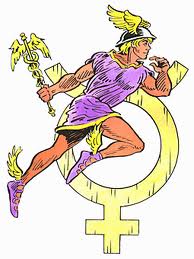 My planet is Mercury. It's name comes from the Greek god Hermes (the messenger god) and the Roman god Mercury (god of commerce, thievery, and travel). It was discovered by the Babylonin's because it is visible in the sky. *Behind Hermes is Mercury's sign. Notice the wings on his feet and shoes which show up on the sign. Circle= head, half circle= wings on helmet,
cross at bottom= wings on feet.*
Mercury is the closest planet to the Sun. It doesn't have much of an atmosphere because of its closeness to the Sun, the solar winds blow it away. Also, from being so close to the Sun, the gravitational pull is much stronger, causing the planet to rotate a lot faster. 1 day on Mercury is approximately 59 (Earth) days while 1 year is 88 (Earth) days. Even thought it is close to the Sun, it is one of the coldest planets because the heat isn't trapped by an atmosphere. The temperature ranges from -173 / 427 °C.

MESSENGER stands for MErcury Surface, Space ENvironment, GEochemistry, Ranging. It was the first spacecraft to orbit Mercury. MESSENGER took off on August 3, 2004 and has now been orbiting Mercury for around 5 weeks.
If you want to know more about MESSENGER's orbit, watch this video.. MESSENGER
Interesting Facts:
- The planet is only seen after the Sunrise and before the Sunsets.
- Even though Mercury has a large iron core (1800-1900 km thick), it only has a magnetic field 1% of Earth's. Also, people think the core may be molten.
- While standing on Mercury, the Sun would seem 3 times larger than on Earth.
- It is the second smallest and densest planet in the solar system.
- 13 times every 100 years, Mercury passes in front of the Sun and is visible from Earth. This is called a transit. The next transit is happening on May 9th, 2016.
Tuesday, March 29, 2011
Sophie's Reflection Post
Overall, I think I did a lot better job on my scribe post for this quarter. I added pictures and hyperlinks but could have explained the pictures better (more in depth). Also, I should have added more information about other subjects we talked about during class. Lastly, I could have put a "fun" video to make my post more interesting.
The class blog has it's benefits. Like, it makes us pay more attention in class if it is our turn to scribe. Also, if anyone is gone, it is very helpful to be able to go to the blog and see what they missed. Another reason, others who don't go to our school get to see what we do and learn in science class in an other part of the world. The only thing I don't like about blogging is that Blogger isn't that easy to use and sometimes you can't do everything you want.
Wednesday, March 23, 2011
22/3/11 Science Class


First, we talked about the upcoming homework that is due. This is it:
Thursday, March, 24th (tomorrow)
- Send Ms. D and e-mail about any Astronomy-related topic from TED talks (www.ted.com) with the name of the presenter, the title of the video, and 5 things you learned. Also, if you think the presenter was a good presenter or not.
- How many Apollo missions to the moon were there?
- How many men officially walked on the moon?
Friday, March 25th
-Last blog comment, make sure you know whether to do 7th or 8th grade.
After our class discussed the homework, Ms. D reminded us how our 2nd APOD was due.
Then, we finished our diagram of the seasons (equinox, solstice, etc.) as we added the southern hemisphere. Here is what we wrote on our diagram:
Northern hemisphere: Vernal equinox - March 21st, equal day and night
Winter solstice - December 21st, longest night and shortest day, points away from sun
Autumnal equinox - September 23rd, equal night and day
Summer solstice - June 22nd or 23rd, points towards sun, longest day and shortest night
Southern hemisphere: Autumnal equinox - March 21st, equal day and night
Summer solstice - December 21st, longest day and shortest night
Vernal equinox - September 23rd, equal day and night
Winter solstice - June 22nd or 23rd, longest night, shortest day
Ms. D later showed us a video about the Earth with it's equinoxes and solstices (seasons).
After, we went through a P.P about the moon and took notes. These are some of the notes:
-Waxing = bigger
- Waning = smaller
- About 4.6 billion year old
- 384,000 km from the Moon to Earth
- The Moon orbits the Earth at 3,700 kmph
- The gravity of the Moon = 1/6 of Earth
- There is no atmosphere and that's why foot prints don't disappear
- Galileo was the first with a telescope
- There is a Gravity Lock with Earth which means that it is always in orbit with Earth and the distance always stays (about) the same
- You can only see 1 side of the Moon
- Gravity does NOT equal magnetism
- There is 1 lunar cycle = 29.5 days
- Full Moon rises at sunset
- Everyone can see the same thing in the sky
- In craters, ice deposits have been found
- Tides are controlled by the Moon
After that, our class did a fun exercise with Oreos. We had to create the 8 phases of the Moon with 2 Oreos and the white frosting from them. For example, new moon, waxing crescent, first quarter, waxing gibbous, full moon, waning gibbous, third quarter, and waning crescent. The best part was we got to eat them after!
Next, we started the Moon Lab. We labeled it in our notebooks and got started. Our class didn't get to finish, but will continue it on Thursday.
The next scribe is Antonia! :)
Wednesday, January 19, 2011
Sophie's Reflection Post
Overall I don't think I did too well for the first semester of blogging. The things I did good and bad were:
-I should have put a better color that was easier to read in one spot.
· - I should have put pictures.
· - I gave the homework but I needed to define the words I listed and the information in bold.
· - I had to label my name in the labels also.
· - I should have put a link to Moodle and also the BBC video I talked about.
· - I should have given the book’s name that the questions were from.
- My post was a little too short.
~ ~ The colors I chose - except for one - added to my post.
~ ~ I gave the homework and what pages the homework was on.
~ I said what we did in class.
~ I didn't make any grammatical or spelling mistakes.
In the 3rd quarter I will improve my scribe post my first reading the rubric. Then I will look at my old post and the comments so I will know what to do and not do so I don't make the same mistake twice. I will surely put my name on the label, put a link to Moodle, and put at least 1 picture.
A benefit of having the blog is if someone is gone that day, they will most likely know what happened. I enjoy doing the blog for this reason and I think we should keep on blogging. The only things bad about the blog is it is sometimes hard to use with the text.
Subscribe to:
Posts (Atom)