Neo Earth

Showing posts with label Science. Show all posts

Monday, May 2, 2011


CERES PRESENTATION DONE ON THURSDAY 21 APRIL


(Sorry about the size of the picture I couldn't figure out how to make it smaller.)


Discovery:


Ceres was the first thing to be discovered in the asteroid belt. Sicilian astronomer Father Giuseppe Piazzi first saw this dwarf planet in 1801. When more objects were discovered in the same area they were called asteroids or minor planets. Ceres was first called a planet but was then renamed as an asteroid. In recognition of its planet like aspects it was designated a dwarf planet in 2006 along with Pluto and Eris.


(Ceres' Symbol above)


Overview:


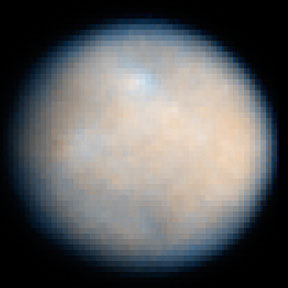
Ceres is described by scientist as the embryonic planet. Gravitational perturbations from Jupiter eons ago prevented it from becoming a normal sized planet. Ceres ended up among the debris left over from planetary formation in the asteroid belt between Mars and Jupiter. The Hubble Space Telescope observed the planet and it demonstrated and orbit that suggests it has a nearly round body. Its diameter is larger at the equator than at the poles. This planet is around the size of Texas. Pluto is 24 times bigger than Ceres.


Composition:


Ceres does not have the same composition as the rest of its neighbors. It I made up of three layers the first being its dusty outer layer than the water ice inner layer and finally the stone core. Astronomers believe that there is water within Ceres because the density of the planet is less than that of the Earth’s crust. Another reason is that the surface of Ceres shows evidence of water bearing minerals.


Ceres' composition


The numbers:


Orbit size


Metric: 413,690,250 km


Scientific Notation: 4.1369025 x 10⁸ km (2.7653485 x 100 A.U.)


Perihelion (closest)


Metric: 380,951,528 km


Scientific Notation: 3.80952 x 10⁸ km (2.547 x 100 A.U.)


Aphelion (farthest)


Metric: 446,428,973 km


Scientific Notation: 4.46429 x 10⁸ km (2.984 x 100 A.U.)


Mass


Metric: 947,000,000,000,000,000,000 kg


Scientific Notation: 9.47 x 10²⁰ kg


Density


Metric: 2.09 g/cm3


Surface area


Metric: 2,849,631 km2


Scientific Notation: 2.8496 x 10⁶ km2


Length of Day


0.378 Earth days


9.07417 hours


Length of Year


4.6 Earth years


Orbit Eccentricity(the shape of the orbit)


0.079138251


Orbit inclination (what its angle is from our perspective)


10.59


Links to Moodle


Tuesday, April 12, 2011

Mercury


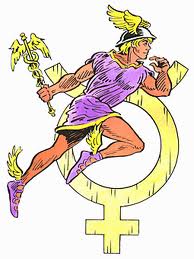
My planet is Mercury. It's name comes from the Greek god Hermes (the messenger god) and the Roman god Mercury (god of commerce, thievery, and travel). It was discovered by the Babylonin's because it is visible in the sky. *Behind Hermes is Mercury's sign. Notice the wings on his feet and shoes which show up on the sign. Circle= head, half circle= wings on helmet,


cross at bottom= wings on feet.*


Mercury is the closest planet to the Sun. It doesn't have much of an atmosphere because of its closeness to the Sun, the solar winds blow it away. Also, from being so close to the Sun, the gravitational pull is much stronger, causing the planet to rotate a lot faster. 1 day on Mercury is approximately 59 (Earth) days while 1 year is 88 (Earth) days. Even thought it is close to the Sun, it is one of the coldest planets because the heat isn't trapped by an atmosphere. The temperature ranges from -173 / 427 °C.


MESSENGER stands for MErcury Surface, Space ENvironment, GEochemistry, Ranging. It was the first spacecraft to orbit Mercury. MESSENGER took off on August 3, 2004 and has now been orbiting Mercury for around 5 weeks.


If you want to know more about MESSENGER's orbit, watch this video.. MESSENGER


Interesting Facts:


  • The planet is only seen after the Sunrise and before the Sunsets.


  • Even though Mercury has a large iron core (1800-1900 km thick), it only has a magnetic field 1% of Earth's. Also, people think the core may be molten.


  • While standing on Mercury, the Sun would seem 3 times larger than on Earth.


  • It is the second smallest and densest planet in the solar system.


  • 13 times every 100 years, Mercury passes in front of the Sun and is visible from Earth. This is called a transit. The next transit is happening on May 9th, 2016.

Tuesday, December 7, 2010

The class of t 7 December


(This is a diagram for a part that is farther down.
Pleace click on it. It will be more readeble.)


Hy!

Today in class we first redid the lab we did last class because it didn't really work.

Than we talked about pigments and how we see colors.

Our next theme was photosynthesis and respiration. While we were talking some of the test tubes popped.
Here is a song about photosynthesis:
http://www.youtube.com/watch?v=tSHmwIZ9FNw
This will tell you what photosynthesis.
Celliar Respiration: (not breading)
-happens in cells


-1st stage: (happens in the cytopats)
× takes the foodand breaks it down into smaller molecules (small energy produce
× sends CHO (charbohydrates), proteins, and fats to the cell to be used as energy.
× takin glucos and providing energy.


-2nd: (happens in the mitochondria)
× glokos + oxigen = reaction (no light)
× produces a lot of energy
× C6H12O6 + 6O2 = 6CO2 + 6H2O + energy


After this we did genedicts , because we have flover babies( these are sackes of flower that you have to carry around everywhere like baby) and they nead faces. We were flipping coins so we couldfinde out hove our baby will look.

The homework was to draw the face. http://zagreb.ceesa.net/


The next scribe is Val.

Monday, November 22, 2010

Class of Thursday 18, 2010

Hello everyone,
Here is the link to Moodle, to check homework:
http://zagreb.ceesa.net/course/view.php?id=189

Thursday in our science block we reviewed first of all the Periodic Table of Elements. We learned some symbols for some of the elements on the table because it would have shown up on our Quiz. After that we watched a few videos from Brainpop, (http://www.brainpop.com/) about cellular life, linked here:
  1. http://www.brainpop.com/science/cellularlifeandgenetics/cellstructures/preview.weml
  2. http://www.brainpop.com/science/cellularlifeandgenetics/activetransport/
  3. http://www.brainpop.com/science/matterandchemistry/diffusion/
  4. http://www.brainpop.com/science/cellularlifeandgenetics/photosynthesis/
  5. http://www.brainpop.com/science/cellularlifeandgenetics/plantgrowth/
After watching the videos, we reviewed pages 32- 37 in our book Science Explorer. Throughout the reading we reviewed the definitions of the following words:

  • Diffusion: main method by which small molecules move across the cell membrane.
  • Osmosis: diffusion of water molecules through a selectively permeable membrane.
  • Selectively permeable: some substances are able to pass through the membrane while others are not.
  • Passive transport: the movement of dissolved materials though a cell membrane without using NRG.
  • Active transport: the movement of materials though a cell membrane using cellular NRG.
  • Exocytosis: movement of proteins leaving the cell across cell membrane.
  • Endocytosis: movement of proteins coming into cell across cell membrane.
An example of diffusion.

Also, here is the link to the YouTube video about diffusion and osmosis we had to watch:
http://www.youtube.com/watch?v=K3wG337xmQc&feature=related

One more thing we reviewed for the Quiz is the Mrs Gren method:

Movement
Respiration
Sensitivity
-
Growth
Reproduction
Excretion
Nutrition

This was it for Thursday's class.
The next scribe is Fabi.

Gio

Monday, November 15, 2010

Science: November 15th, 2010

This past science class on Friday we started off with a short video about a show called Life on BBC. Then we had the whole class to work on the following, what we didn't finish in class was homework for Tuesday November 16th.

Pages 32-37 ~ Define the following words in your notebook or in your notes on the computer:
  • Selectively Permeable
  • Diffusion
  • Osmosis
  • Passive Transport
  • Active Transport
  • Transport Proteins -Page 40~answer questions 20, 21, 22, 24, 25, 26

Pages 44-48~ define the following words in your notebook or in your notes on the computer:


~Photosynthesis (including writing out & understanding the equation explaining what is happening chemically)

~Autotroph
~Heterotroph
~Pigment
~Chlorophyll
~Stomata

Also, you had to write any text that was in bold.

The next scribe is Antonia! :)